Monday, April 23, 2012
In the neighborhood.
Spigolo has been a big part of the neighborhood's self-improvement plan. It opened a few years back, and has been serving delicious Italian food to standing room only crowds ever since. Every time I visit, I realize I don't go often enough.
On my most recent trip, I started with a house cocktail, the Bulleit Burlesque. A mixture of rye, cherry and ginger (I honestly can't remember the exact ingredients), it was a spicy take on a Manhattan - so of course I loved it.
For my starter, I ordered Spigolo's take on the Caesar, a half head of romaine topped with anchovy dressing, Parmesan and piping hot, lightly fried rock shrimp. I loved the flavors in this, but it was a bit overdressed. I ended up pushing about half the sauce to the side - but nothing could ruin the contrast of the plump, toasty shrimp with the crisp, cold lettuce.
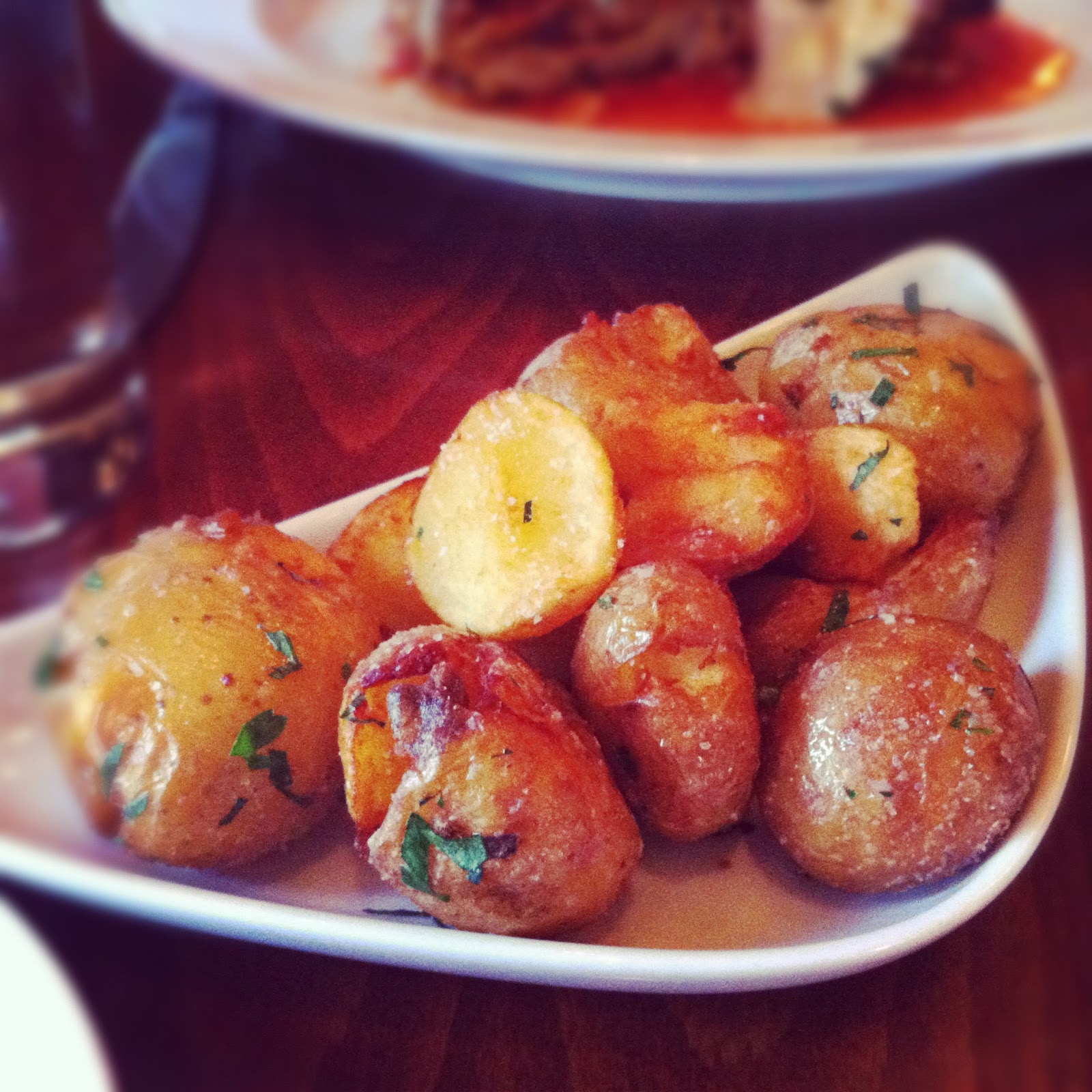
On my insistence, Kyle and I split an order of the Romano potatoes. From what I can tell, these bad boys are boiled, then smashed, coated with a bit of cheese and salt, and crisped on the grill. They are, in a word, ridiculous.
I was lucky enough to visit early in the evening, before the restaurant sold out of their house-made chicken and broccoli rabe sausage, which was split, grilled and served on top of a cold farro salad. The sausage - unlike so much chicken sausage - was moist, flavorful and a perfect texture. And the salad was a little creamy and peppered with roasted tomatoes and cold cucumber. So, as you can imagine: I loved it.
Dessert at Spigolo is particularly good - the co-owner is also the pastry chef, and she does a fantastic job. My favorite of the two we sampled last week was the sticky toffee bread pudding. I'd even go so far as to say that the sticky toffee sauce was as good as my own, and I loved the whipped cream/mascarpone combination that topped things off. (So much so that I might copy it.)
Over the next few weeks, I'll be offering up a few more reasons why the Upper East Side isn't seeming like such a bad place to be these days. Stay tuned! In the meantime, get your butts to Spigolo before they take that bread pudding off the menu.
Spigolo
1561 Second Avenue
Between 81st and 82nd Streets
212.744.1100
Friday, November 12, 2010
Wowza.
But only when I started making Saveur's recipe for the incredibly old-school casserole chicken Divan did I realize what I'd gotten myself into. This is a recipe that calls for - I kid you not - butter, whole milk, cream, cheese and flour. Yeah. I know. Not my usual weekly lunch fare. But, you know, sometimes it's okay to fold whipped cream into your cheese sauce and pour it over chicken and vegetables and then bake it.
Really.
The good news is that the resulting dish is tasty, and not just in a happily retro kind of way. It's rich, yes, but there's just enough sauce - not too much - to coat the peppery broccoli and tender chicken, and the nutmeg makes things nice and wintry. I used a healthy amount of salt and skipped the almonds, since I'm not a big fan, and I'm convinced it's just as good as it would be with nuts. (Though I do think walnuts or pine nuts would be worthy substitutes.)
In short, I highly recommend indulging yourself with a little cheese sauce casserole sometime soon. If nothing else, you'll get to tell people you had whipped cream for dinner.
Monday, October 25, 2010
It's time for a braise.
And so, when I spotted a Martha Stewart recipe for braised chicken on Lonny's blog the other day, and was instantly smitten. Shallots, garlic, tomatoes, chicken, wine and mustard? Sign. Me. Up. I didn't have any tarragon on hand, but I thought I could make do very well with the parsley I did have. When the kosher butcher down the block turned out to be running a special on chicken, I knew this was the right thing to make for Sunday night supper. (And, of course, for my lunches this week. Nothing keeps as well for as long as a braise.)
Like so many braises, this one starts out with a browning stage. Since the chicken is skinless, coating it in a light flurry of flour gives it a bit of heft. That flour also helps thicken the sauce later on. After the browning come the shallots and garlic, and then the wine, mustard and stock. (Water works, too, if you don't have stock in the house.) A long simmer and a few tomatoes later, you have a dish fit for a king.
I ate mine with a healthy chunk of baguette and a cold glass of white wine. Heaven.
Mustardy Braised Chicken with Shallots
Adapted from Martha Stewart's Everyday Food Fast
1/4 cup all-purpose flour
4 bone-in, skinless chicken thighs (1 1/2 pounds)
Kosher salt and freshly ground pepper
1 tablespoon olive oil
5-6 small shallots, peeled and halved lengthwise
4 garlic cloves, halved lengthwise
1/2 cup dry white wine
3 tablespoons Dijon mustard
1 1/2 cups chicken stock (or water)
1/2 pint cherry or grape tomatoes, halved
1/4 cup finely-chopped parsley
Place flour in a shallow bowl. Pat the chicken dry with paper towels. Season on both sides with salt and pepper and dredge in flour, turning to coat and shaking off excess.
In a Dutch oven or heavy 5-quart pot with a tight-fitting lid, heat oil over medium-high. Cook chicken until browned, 3 to 4 minutes per side. Transfer to a plate. If necessary, cook the chicken in batches - whatever you do, don't crowd the pan.
Add shallots and garlic to pot; cook, stirring occasionally, until slightly softened and golden brown, about 3-5 minutes. Add the wine and cook until nearly evaporated. Stir in the mustard and stock, and bring the sauce to a boil.
Return chicken, bone side down, to pot, nestling them into the sauce. Reduce heat to a simmer. Cover the pan and cook until chicken is tender and cooked through (juices should run clear when pierced), 25 to 35 minutes. Transfer chicken to a plate, leaving the rest of the stew behind.
Add tomatoes and 3/4 of the parsley to pot; season with salt and pepper. Cook the mixture over high heat until tomatoes soften and sauce thickens, 6 to 8 minutes. Reduce heat to medium-low, and return chicken to pot; cook until heated through. Taste and adjust seasonings before serving. Garnish with remaining parsley before serving.
Saturday, October 2, 2010
Chicken/birthday, part 2.
Friday, June 18, 2010
Minimal cooking required.
- Chopped romaine lettuce
- Chopped Kirby cucumber
- Corn (either cut off of a raw cob, or defrosted from the freezer)
- Cold chicken
- A potato or two, boiled and sliced
- A radish or two, thinly sliced
- Snap peas
Arrange it all artfully atop a bed of the lettuce, top with some vinaigrette, and there you have it: the perfect warm weather meal. Expands or contracts to serve one or many.
Go ahead; give in to the laziness. You won't regret it.
Wednesday, May 26, 2010
Best. Chicken. Ever.
On the Thursday night I spent in San Francisco, Mom, Faith and I paid a visit - a pilgrimage, really - to the legendary Zuni Café on Market Street. Zuni opened in 1979, and Judy Rodgers became the chef there in in 1987. She's the one who installed the brick oven that sits in the heart of the space, and she's the one who created what turned out to be the best roast chicken I have ever eaten.Seriously.
This chicken was insane. Moist, rich, full of flavor, and served with a warm bread salad that put every single helping of stuffing I've ever enjoyed into an entirely subpar category.
I can't wait to recreate this one myself; I'll be following Smitten Kitchen's slightly simplified version of Rodgers' recipe. Join me, won't you?
Zuni Café
1658 Market Street (Between Franklin and Gough)
415.552.2522
Photo courtesy of Ann&Ming on Flickr.
Saturday, March 20, 2010
Queenie's Treasury
First, what seem to be the ultimate answer to (the pure, unadulterated nastiness that is) the Cadbury Creme Egg. Vosges has created a series of Easter eggs, the most intriguing of which (to me, at least) are the Wink of the Rabbit (caramel, pecans and dark milk chocolate) and the Bacon and Eggs (bacon caramel and dark chocolate). These will definitely be making an appearance in my Easter basket. Swoon.
Next, a recipe for Dijon chicken from Kerry Saretsky's French in a Flash series over on Serious Eats. This looks like a delicious, easy one-pot meal, and I predict that I will make it for lunch sometime soon. Mustard and wine and thyme - what could be better?
Finally, some ridiculously delicious looking apple dumplings. These look absolutely insane. I must have them. Now. Immediately. Many thanks to Design*Sponge and their contributor, food photographer Stacy Newgent, for making my day.
Tuesday, February 23, 2010
A little light reading.
The book is, in fact, billed as a "love story with recipes," so I was excited to read it and get inspired. I was a bit disappointed, as the food mentioned - and often described with loving tenderness - rarely matched the recipes presented at the close of each chapter. (The thematic connections were there, to be fair.) That said, some of the recipes that were included seemed interesting, most notably Chapter Three's poulet basquaise.
Basque cooking is perhaps best known for its inclusion of piment d'espelette, a dried pepper that is the region's answer to paprika. It's delicious, sweet and smoky and spicy and complex. I love it, but had never cooked with it before. One order from Kalustyan's later, I was ready to get moving.
Poulet basquaise combines the d'espelette pepper with fresh sweet peppers and copious amounts of onion. Not everyone's cup of tea, surely, but I've rarely heard two words I love more than "onions" and "peppers." The recipe also called for a decent amount of bacon, some canned tomatoes, and had a fabulous sauce to meat ratio (read: high).
However. For an entire chicken, 28 ounces of tomatoes, 8 ounces of bacon, three peppers and four onions, Bard calls for only 2 teaspoons of espelette. Sorry, honey - not gonna cut it for this pepper lover. In fact, the recipe in general seems written for someone who's already a pretty comfortable cook; for example, she asks you to brown the chicken in a skillet, but doesn't offer a suggestion for which fat to use. So, I've taken it upon myself to put her fantastic formula into a format that will hopefully work for you - it's a bit time-consuming, as one-dish meals go, but it's truly delicious, and it fed me for five days.
You can't beat that.
Poulet Basquaise
Adapted from Elizabeth Bard's Lunch in Paris
One whole chicken, cut into six pieces (or six assorted legs & thighs)
3 tbs. piment d'espelette*, divided
Kosher salt
2 tbs. neutral oil, such as canola
3 slices bacon, cut crosswise into batons
2 white onions, thinly sliced into rounds
3 cloves garlic, halved lengthwise
3 red bell peppers, ends removed, sliced into 1/2 inch rounds
3 tbs. sherry vinegar
28 ounces plum tomatoes, with juice
1 bay leaf
4-5 sprigs thyme, leaves removed and stems discarded
3 tbs. parsley, finely chopped
Pat the chicken dry and place, skin-side up, on a plate. Season the chicken, on the skin-side, with a teaspoon or so of the d'espelette and a pinch of salt. In a large saute pan or dutch oven, heat the canola oil over medium-high heat. Place the chicken in the oil, skin-side down, and cook until golden brown. Meanwhile, season the bottom side of the chicken with another teaspoon of d'espelette and a pinch of salt.
Turn the chicken and brown on the other side, then remove the chicken pieces to a plate to rest. (Brown chicken in batches if need be; do not crowd the pan.)
Add the bacon to the pan and cook over medium heat for several minutes, until most of the fat is rendered, but the bacon isn't quite crispy. Remove the bacon with a slotted spoon and set aside. Pour off all but a couple of tablespoons of the fat in the pan and place the pan over medium heat. Add the onions and garlic and cook slowly until the onions are well-softened, about 10 minutes. Add the peppers, a tablespoon of d'espelette and half a teaspoon of salt. Continue to cook over medium heat until the peppers are very soft, about 15 minutes.
Deglaze the pan with the vinegar, and then add the tomatoes one by one, crushing them between your fingers as you go - and don't forget their juice! Return the bacon to the pan and add the remaining d'espelette, bay leaf, thyme and parsley. Bring the mixture to a simmer, place the chicken on top, and cover. Keep the pan cooking at a simmer for 30 to 40 minutes. Remove the bay leaf, adjust for seasoning, and serve.
I like to serve this with couscous, which does a great job of soaking up the sauce. Since I ate most of the stew well after it had been made, I added a few pinches of fresh herbs to the couscous to brighten things up.
Serves 4-6 people. The sauce is more filling than you'd expect.
*If you can't find piment d'espelette, hot (not sweet) paprika makes a good substitute.
Wednesday, January 20, 2010
Resolution: kept!
About a year ago, I resolved to bring my lunch to work at least three days a week, and with very few exceptions, I've done it! One of the ways I manage it is to make something on Sunday that will see me through a lunch or two. Braised dishes and stews are fantastic for this, since they not only keep well, but actually get better after a couple of days in the fridge.(A quick aside: I highly recommend bringing your lunch to work. Not only do you save money, you also eat so much more nutritiously and consciously. It's made a huge difference to my working style, too - since I don't have to run out for fifteen or twenty minutes in the middle of every day, I can more easily meet with people over lunch or run out to do errands at 3:00, when the stores are empty. I love it.)
I've made chicken with barley and a (somewhat) traditional coq au vin, but one of my favorite braised chicken dishes is one I've adapted from a recipe I first made during my eGullet days. My friend Susan created this recipe, and I've loved it from the very first bite. She makes hers with fresh plum tomatoes and creme fraiche; I sub in half-and-half, since it's what I keep in the fridge for my coffee, and during the winter I use canned tomatoes - but, in spirit, it's still the same dish.
And I'll be damned if it isn't delicious. It's substantial from the vegetables, creamy from the cooking time and the half-and-half, and tangy from the vinegar. During the summer, I use basil and parsley to season things, but this time of year I keep it wintry with a little woodsy thyme. Most of the time, I eat it by itself, but it's also fantastic with buttered noodles or some mashed potatoes. Really, anything goes. Anything at all.
Susan's Braised Chicken with Tomatoes & Vinegar
1 tbs. canola oil
Dark meat of one chicken (two legs, two thighs, two wings)
1/2 white onion, cut into a 1/4-inch dice
2 cloves garlic, thinly sliced
1 small carrot, peeled and cut into a 1/4-inch dice
1 stalk celery, cut into a 1/4-inch dice
1 tbs. fresh thyme leaves
1/8 cup white wine or champagne vinegar
1/2 cup white wine
14 oz. whole canned plum tomatoes in puree, crushed with your hands
1 or 2 tbs. half-and-half, milk, creme fraiche or cream
Salt and freshly ground pepper
In a 3-quart, heavy-bottomed pot (enameled cast iron is ideal), heat the canola oil over high heat. In the meantime, season the skin side of the chicken pieces with salt and pepper. Once the oil is hot enough (a droplet of water should sizzle and skitter across the surface), place half the chicken pieces in the pot, skin side down, and turn the heat to medium high. Cook until the chicken is well-browned on one side, then flip and cook for a few more minutes. Using tongs, remove the cooked chicken to a plate and repeat with the rest of the chicken.
Pour off all but 1 tbs. of the fat from the bottom of the pot and return to the heat. Add the onion and saute for a few minutes until softened and a little browned. Add the garlic and saute for a minute or two more, until the garlic is fragrant and slightly golden. Add the carrots, celery, thyme and a pinch of salt; saute until the vegetables soften, about five minutes.
Deglaze the pan with the vinegar, then add the wine. Simmer for a couple of minutes and then add the tomatoes (with their puree). Stir to combine evenly, then add the chicken back to the pot, nestling the pieces in the vegetable mixture. sprinkle with a bit more salt and some pepper, then turn the heat to low, cover and simmer (Do NOT boil!) for 25 to 30 minutes.
Once the chicken is cooked through and the sauce has turned a bit creamy-looking, remove the chicken to a plate and stir the sauce. Add the half-and-half and stir to combine. If you're planning to store the stew overnight (or longer), add the chicken back to the pot and let things cool down a bit on the stovetop. Once the pot is no longer hot to the touch, place in the fridge. The dish keeps for five or six days, easily.
If you plan to serve immediately, taste and adjust for seasoning, then place a piece or two of chicken on each plate and top with plenty of sauce.
Serves three.
Tuesday, January 19, 2010
Road trip!
This past Saturday, I drove up to Rhode Island to visit my aunt and uncle in Bristol. They were hosting a 30th birthday party for my cousin Kate, who's been one of my closest friends pretty much since time began. (See the photo below for evidence.) We had a fantastic time - my Aunt Cathi cooked up a storm, including some of the most delicious chicken Marsala of all time (the secret is roasting the mushrooms and onions separately and with lots of balsamic vinegar).Chicken nuggets, fries and Sweet & Sour sauce: pure, salty perfection. Yum.
Saturday, January 9, 2010
Queenie's Treasury
And then I realized - hey, I need to write a Treasury post! So here I am, and here we go.
Next, a potentially exciting development in the world of unctuous goodness: could chicken skin be the next bacon? As a major fan of Kasadela's grilled chicken skin on a stick, I applaud this potential shift, especially it's tip-to-tail sensibility. Bring on the crispy skin, I say.
Finally, something that makes your brain happy, as opposed to just your tummy. Some gorgeous, fun pieces from pop pop portraits, one of my favorite Etsy sellers. I just love Helena's fashion-oriented, nostalgic aesthetic. I wouldn't mind having her paint my portrait, so long as she helps me choose the outfit as well. (Discovered these a while ago, but was reminded of them by PVE Design!)
Friday, November 27, 2009
A happy accident.
Turns out, they were a batch of the biggest purple radishes I have ever seen. I made this discovery when I started slicing them for a roasted beet and cucumber salad. Not to be deterred, I decided to roast the radishes instead, and to add some sliced carrots to replace the sweetness of the beets.
It also turns out that roasted radishes and carrots make a pretty damn good salad when tossed with cucumber, dill, onion and a lemon vinaigrette. The salad went perfectly with my roast chicken thigh, and I had to restrain myself from eating the second half of the meal, which had been earmarked for Monday's lunch.
All in all, a good showing.
Roast Chicken with Radish, Carrot and Cucumber Salad
Olive oil
1 bunch radishes, washed and cut into one-inch pieces
1 large carrot, peeled and cut into half-inch thick half-moons
Salt and pepper
2 chicken thighs (bone-in, skin-on)
2 kirby cucumbers, seeded and cut into one-inch pieces
1/4 large white onion, thinly sliced
3 tbs. fresh dill, finely chopped
1 small shallot, minced
1 teaspoon Dijon mustard
Juice of one lemon
1 tsp. honey
2 tbs. canola oil
Preheat the oven to 425°F. Line a baking sheet with aluminum foil and brush the foil with a bit of olive oil. Spread the carrots and radishes evenly on the foil, drizzle with a bit more olive oil, and season with salt and pepper. Place in the preheated oven and roast for 25-35 minutes, stirring once or twice, until tender and beginning to brown deeply.
Meanwhile, pat the chicken thighs dry, brush another baking sheet with olive oil (no foil this time), and place the chicken thighs on the sheet. Season with salt and pepper and add to the oven. Roast for 30-40 minutes, until the skin is crisp and golden, and the meat's juices run clear. Set aside to rest for 5-10 minutes.
Place the cucumbers, onion and dill in a medium bowl. In a small bowl, whisk together the shallot, mustard, lemon juice, honey and a bit of salt and pepper. Add the oil in a small stream, whisking as you go, until the mixture is emulsified. Set aside.
Once the roasted vegetables have cooled for a minute or two, add them to the cucumber. Add half of the vinaigrette and toss the salad until all ingredients are evenly distributed. Taste and add more vinaigrette as needed, and season with salt and pepper to taste.
Spoon the salad evenly onto two plates, and place a chicken thigh on top of each little pile. Serve warm or at room temperature.
Serves 2.
Friday, November 6, 2009
The healing powers of a broth.
I've had a nasty cold for the last few days, and haven't been able to taste much of anything. I have, however, been craving all things brothy and spicy. I ordered some curry noodle soup from my local Vietnamese delivery place a couple of times, but decided on Monday that it was time to take the situation into my own hands.It was time to make chicken noodle soup.
I don't have a family recipe for chicken noodle soup, but I figured I could suss it out. I chopped some carrots, celery and onion, added a bit of mustard and tomato paste for a round flavor, and added stock from my freezer. (And I do mean straight from the freezer - I didn't bother thawing it first; just let it melt right there in the pot.)
When I'd finished the first batch, it tasted good, but just a tad flat. I remembered an old chef's trick: add a dash of vinegar to a sauce or soup at the end of the cooking process to brighten it up and add dimension. I grabbed the sherry vinegar, added a shot, sprinkled in a bit more salt, and ended up pretty dang happy.
Now, I don't know about you, but one of the worst side effects of my colds is that my sense of taste is seriously dulled. The one thing that really satisfies me? Heat, of the spicy variety. So I've been eating my chicken noodle soup with healthy squeezes of Sriracha. You may or may not care to follow my lead here. I'll tell you what, though - it really clears the sinuses.
Queenie's Penicillin (Chicken Noodle Soup)
Because I wrote this recipe while I had a bad cold, I used an awful lot of salt. My advice on salt is to add small amounts throughout the cooking process, and to taste as you go. Salt should enhance flavors, not be a flavor in and of itself.
1 tbs. olive oil
1/2 medium white onion, chopped
2 cloves garlic, barely bruised with the back of a knife
1 large carrot, cut it half and thinly sliced into half-moons
2 stalks of celery, sliced (including tops)
2 tbs. flat-leaf parsley, finely chopped
3/4 tsp. dried thyme
1 tbs. Dijon mustard
1 tbs. tomato paste
2 quarts (8 cups) chicken stock
1/2 cup frozen peas
2 cups cooked pasta (cooked to just barely al dente)
1 1/2 cups cooked chicken, chopped into 1-inch pieces
1 tbs. sherry vinegar
Salt and freshly ground pepper
Heat the olive oil in a 4-5 quart, heavy-bottomed pan (I use my enameled cast-iron dutch oven) over high heat until shimmering. Turn the heat to medium-high, add the onion and saute until transluscent. Add the garlic and saute a minute or two more, then add the carrots and celery. Salt the vegetables (about 1/2 tsp. should do it) and saute until they begin to soften, about 3-5 minutes.
Add the parsley, thyme, mustard and tomato paste, and stir them all into the vegetable mixture. Allow to brown a bit, then add the stock. Generously salt and pepper the soup, bring to a simmer, then cover the soup and reduce heat to medium. Simmer the soup for 8-10 minutes.
Add the peas and pasta and taste for seasoning; you don't want to over-salt, but if you add a bit of salt now, it will make a rounder flavor than if you add all the salt at the end. Simmer the soup with the peas and pasta for a few minutes, then add the chicken. Simmer for another couple of minutes. Add the vinegar and stir to distribute.
At this point, you can either adjust the seasonings and serve immediately, or cool the soup, chill it in the fridge, and reheat on the stovetop later. Again - don't forget to check the seasonings before you serve!
Serves 3-4.
Thursday, October 22, 2009
Inspiration in the workplace.
Ever since I started my new role in January, I've been eating lunch with a bunch of colleagues from my new floor. I knew all of these folks by name before I moved to the new group, but I'd never spent a lot of time with them. Little did I know how food-obsessed all of them are, and little did I anticipate the ideas and inspiration I'd get from our daily talks about what we like to eat.A few weeks ago one of the more avid cooks in the group, my friend Connie, told us about a dinner she'd made recently: a coq au vin-esque one-pot meal of chicken, barley and cabbage. The whole thing sounded so deliciously autumnal that I ran back to my office and added Savoy cabbage and barley to my FreshDirect cart right then and there.
This weekend I finally had a chance to work on the recipe itself (Connie had improvised her version, so I needed to recreate it.), and I can't get enough. It's nutty and hearty and rich, but not actually bad for me. I made the whole recipe, and ate it for lunch all week. Hopefully Connie approves.
Connie's Chicken with Barley and Cabbage
One whole chicken, cut into eight pieces (or five whole chicken legs, drumstick and thigh)
Olive oil
1 large shallot, chopped (about 1/2 cup)
2 small celery stalks, including leaves, chopped (about 1/2 cup)
2 garlic cloves, peeled and slightly bruised
1 tbsp. tomato paste
1 cup barley
Salt and pepper
1/2 cup dry white wine
1/2 cup water
2 cups chicken stock
1 tbsp. Dijon mustard
1/2 head of Savoy cabbage, shredded
5-6 thyme stalks
1 Gala apple, peeled and cut into 1/2 inch cubes
Rinse the chicken and pat dry with paper towels. Salt and pepper the skin side of the chicken pieces. Heat a heavy-bottomed, 5-7 quart pot over high heat. Add enough olive oil to just coat the bottom, then add the chicken pieces, skin-side down, in one layer. (If you can't fit all the pieces in one layer, brown the chicken in multiple batches; don't crowd the pan, or the chicken will steam instead of browning.) While the skin browns, salt and pepper the other side of the chicken.
Once the skin-sides are golden-brown and slightly crisp (about 5-8 minutes), turn the pieces over and lightly brown the bottoms, about 4-5 minutes. Remove the chicken to a plate and pour off all but 3-4 tablespoons of the fat in the pot. Add the shallots, celery and garlic and cook on medium-high heat until the garlic is fragrant and the shallots translucent, about three minutes. Add the tomato paste, stir to incorporate, and cook for a minute more.
Add the barley and toss with the shallot mixture and the fat. Salt the barley (about a teaspoon should do it) and pepper it lightly. Add the wine, water and chicken stock, then stir briskly with a wooden spoon, scraping the bottom of the pot to loosen any browned bits of chicken skin or shallot.
Add the mustard and stir to incorporate. Add the cabbage, resting it on top of the barley and liquids. Salt and pepper the cabbage (again, about 1 teaspoon of salt should do it.) Then arrange the chicken on top of the cabbage, placing the thyme springs on top of it all.
Turn the heat to medium (you want the mixture to simmer, but not to boil, so keep an eye on it for a bit), cover the pan, and cook until the chicken is done and the barley is tender, about an hour and fifteen minutes. Remove the thyme stalks (all of the leaves will most likely have jumped ship by this point).
Remove the chicken to a plate for a moment. Add the apple to the pot, stir to distribute throughout the barley, and heat the mixture through for a couple of minutes. Taste and adjust for seasoning. Spoon the barley and cabbage onto individual plates, place a piece of chicken on each, and serve.
Serves five to six.
Monday, August 17, 2009
Momofuku fried chicken dinner, or: we almost finished the whole thing, except not really.
A few weeks ago, word came down from on high that Momofuku Noodle Bar would be offering a fried chicken dinner for $100 via their online reservations system. Obviously, I signed up immediately. I knew my brother, Jeremy, would be as excited as I was, and he and my sister-in-law Miriam agreed to join me. We still had two spots open in our reservation, so I consulted the Twitterverse. Sure enough, the lovely and freshly-married Kathryn Yu (who also photographed the meal) volunteered to join us, and to bring her husband Dan along for the fun.Our motley crew met up at Momofuku Noodle at eight o'clock last Thursday. We were the second fried chicken dinner of the night; the restaurant does three (6 PM, 8 PM and 10 PM). The night got off to a serendipitous start when we found out that our waiter was none other than Eric Murdoch, who'd performed as an actor for the first play Jeremy produced here in Manhattan. Eric got us going with a round of the restaurant's justly famous alcoholic slushies (these were watermelon spiked with soju, a Korean rice wine).
Eric told us the chicken would take about 20 minutes to cook, so we decided to kill time by ordering a couple of appetizers. We ordered the pork buns, the heirloom tomato salad with melon and the corn with fingerling potatoes.All were fantastic, though the tomatoes and pork buns outshone the corn a bit. The pork buns, which are the same ones you find over at Momofuku Ssam Bar, are just flat-out insane. Fluffy and chewy and filled with pork belly and lightly pickled cucumbers, they're just ridiculously good. The tomato salad was really interesting; I was surprised at how well the sweetness of the melon complimented the tomatoes instead of competing with them, and the smoky saltiness of the ham crisp brought the whole thing safely back to porky Momofuku land.
The chef sent out a special treat: seared scallops with corn and chili oil. These were delicious as well; we couldn't quite suss out what seasoning had made its way onto the scallops, but it was something truly yummy. The scallops themselves were large, but still tender and moist. And who doesn't love corn?
And then, finally, the main event. A giant - and I do mean giant - platter of chicken was set down on the table, along with a stack of moo shu pancakes and a bowl of gorgeous herbs and veggies, including radishes, carrots, shisito peppers, opal basil, thai basil, mint, bibb lettuce and shiso leaves. Next came a flight of four sauces: hoisin, jalapeño-garlic, bibim, and ginger-scallion.There were two kinds of chicken: half of the meat was dipped in buttermilk and seasoned with Old Bay, while the other half was cooked Korean-style, triple-fried and basted with bibim sauce and vinegar.
The idea is that you take a little of everything - the veggies, the herbs, the lettuce and, of course, the chicken, fold it up in a pancake, add some sauce to your liking, and eat the whole thing. After a few minutes of tearing into the chicken with our bare hands, it became clear why the restaurant had covered the table in a sheet of butcher's paper. We left grease stains everywhere, evidence of how thoroughly we enjoyed ourselves.Overall, our group preferred the Korean chicken to the buttermilk; the meat seemed a bit more tender and well-seasoned, whereas the Old Bay seasoning was confined to the crust of the buttermilk chicken. That said, we enjoyed both offerings and tried to divide our attention as evenly as possible. We didn't want any chicken to feel bad about itself.
We were divided on the topic of the sauces; I was partial to the bibim sauce spiced up with a dash of Sriracha, while Jeremy favored the jalapeño-garlic mixed with the hoisin. Obviously, though, there was something for everyone. The only thing I would do differently? Order a pot of the house pickles to go with everything.
Despite Eric cheering us on, the five of us were not up to the task of eating every last bit. Though I'm sure they were ever-so-slightly disappointed in us, the staff did a crack job of boxing everything up (in three containers) for us to take home and enjoy cold from the fridge.
All of these gorgeous photos were snapped by the very talented Kathryn Yu. You can find more of her work at KathrynYu.com.
Wednesday, April 15, 2009
Cucumbers + chicken = heaven.
Since my mom was staying with me, and had meetings of her own all morning (over the phone, natch), I decided to vacate the premises as best I could. I took the opportunity to hit the market for some chicken, cucumbers and bacon (the better to fuel up for my staycation, of course).
On Tuesday morning, I seasoned said chicken with salt, pepper, and thyme (from my windowsill - it's so nice to have access to fresh herbs at a moment's notice again) and roasted it. It's well-documented on this blog how much I like to have cold chicken lying around at all times. In this case, though, I will admit I had a plan in mind for at least some of the meat.
While the chicken cooled, I set out some vinegar, oil, mustard and an egg yolk on the counter. Once they'd reached room temperature, I whisked the yolk, mustard and vinegar together, adding a pinch of salt and a grind or two of pepper. As I whisked, I drizzled in the oil - drop by drop at first, then in a thin stream, until the egg yolk had taken on all the oil and had become...mayonnaise.
Honestly, if there's a pleasure more basic or delicious than homemade mayonnaise folded with warm chicken, cucumber, chopped shallots, and finished with some chervil and chives, I don't know it. I truly don't.
Queenie's Chicken Salad
Breast of one roasted chicken, cut into 3/4-inch cubes
1 Kirby cucumber, seeded and cut into 1/2-inch chunks
1 small shallot, finely chopped
1 tbs. chervil, finely chopped
1 tbs. chives, finely chopped
1 to 2 tbs. homemade mayonnaise
Salt and pepper, to taste
Combine the chicken, shallot, cucumber, chervil and half the chives in a medium bowl. Add the mayonnaise a bit at a time, folding the ingredients into the sauce, until your salad has the desired consistency. Season to taste with salt and pepper, sprinkle with the remaining chives, and eat as soon as humanly possible.
Serves one, generously.
If you can't find chervil, substitute a teaspoon of flat-leaf parsley. If you don't want to make homemade mayo, substitute two tablespoons of commercial mayonnaise mixed with one teaspoon of sherry vinegar.
Saturday, April 4, 2009
Desperately seeking spring.
This morning, looking through my files for the photos of the ramps stand, I found a whole bunch of meals I made last spring, when the Greenmarket was in full swing and onions, eggs and herbs were spilling out of my shopping bags.
It's been a while since I felt seized by the urge to cook (as opposed to cooking for a purpose or reason, such as - you know - feeding myself), but I can feel it coming back now. I can't wait to make some of these recipes, and try out some new ones, too.
Links to the recipes pictured above:Greenmarket Lettuce aux Lardons
Homemade Mayonnaise
Pork Chop with Nectarines and Pickled Ramps
Fettucine with Bacon and Ramps
Monday, January 19, 2009
Saturday, January 17, 2009
Hunkering down.
If you're not on the East Coast of the States today, you may not know this - but it is really freaking cold out this week. Today, the temperature in Manhattan has hovered around 15 degrees Fahrenheit (it was 9 when I woke up this morning), and it's not going to warm up significantly for at least a few days. Oh, and - we're expecting snow tomorrow and Monday.So what's a girl to do when it's too cold to leave the apartment? Well, first that girl has to come to terms with the fact that she has no food in the house, and is indeed going to have to trek to the grocery store. Then, she starts planning a menu, and not just because having the oven on helps warm up the house.
On deck for me this weekend? Roasted tomato soup, to take to work for lunch this week. Roast chicken and a riff on Ina's roasted shrimp and orzo dish, ditto. Madeleines, for fun. Gougeres, for my friend Cristin's freezer (she's addicted to the ones at Ouest). And a couple of salads - celery remoulade and Mark Bittman's wintry slaw.
Not a bad agenda, I should think. I'm hoping to post a few recipes as the days pass here in the arctic north, so stay tuned!
Monday, November 3, 2008
Autumnal goodies abound.
I set off for the Greenmarket around 9:30 on Saturday morning. Now that the weather has turned a bit more brisk, the crowds are thinner, so it's actually feasible to make a full circuit of the market, check out everything on offer, and then start your shopping. The summertime crowds make me way too antsy for that kind of lingering.
The best part, though, really was dessert. I based the galette on this recipe from Epicurious, sizing it down a bit to serve just the four of us. The whipped cream with cheese (flavored with a bit of turbinado sugar and vanilla, since the cheese was a bit funkier than expected) paired really well, setting off the sweetness and tang of the apples and the rich, buttery pastry. All in all, a good day's work.
Queenie's Whipped Cream & Cheese
1 pint heavy cream
4-6 ounces soft cheese, preferably farmer's cheese or mascarpone dolce
1 1/2 tsp. good vanilla extract (none of that fake stuff - spring for this)
2 tbs. turbinado sugar
In a stand mixer fitted with the whisk attachment (or using a hand-held electric mixer with the beaters attached), whip the cream and the cheese together until it holds soft peaks. Stir in the vanilla and the sugar. Serve immediately, or cover with plastic wrap and store in the fridge for up to 48 hours. Let sit at room temperature for about 10 minutes before serving.
Serves 4-6 as an accompaniment to dessert.